|
To return - press the Back Button on your browser Intelligence 'Intelligence' pervades even the smallest particles of life. One example is the original green plant, going back billions of years, the green slime that covers rotting logs and disfigures our garden ponds. These cellular slime moulds. spend most of their lives as single amoeboid protists, but on a given chemical signal, they link together and form a kind of slug that can crawl short distances in order to find better conditions. Plasmodial slime moulds gather together in a completely different fashion. The single cells swarm together and fuse to form one enormous cell with thousands of nuclei. These giant cells, which are visible to the naked eye are interesting to scientists in the way the giant cell lengthens out into a worm-like shape in order to find food. The amoeba is one of the simplest forms of life. Its cytoplasm, the living cell material outside the nucleus, is constantly passing from one colloidal state to another in order to carry out its characteristic flowing locomotion. The typical amoeba sends out such flowing plasmic processes, called pseudopodia, for the capture and ingestion of its prey. In the sea, there are relatives of the amoeba which typically secrete calcareous shells perforated with tiny holes to allow their exceedingly fine pseudopodia to extend in all directions. On account of these fine holes, they are called Foraminifera. They feed upon smaller organisms which they catch in a network of these branching and anastomising protoplasmic strands; they are web and spider all in one. On capturing prey, their meshes close about it, digest it outside their shell and the dissolved food then flows inwards to the main body. The skeletons of some microscopic sponges consist of fine spicules of silica, and when they die, these minute spicules are left scattered on the sea-bed.
|
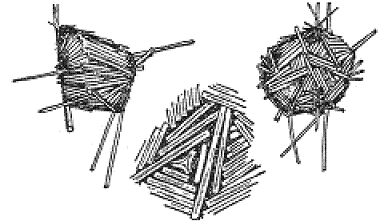
These sketches of these houses built of sponge spicules have been magnified 50 times. They are actually less than one millimetre across. The detail of their construction has been magnified even more. Illustrations in Journal of Royal Microscopical Society 1912 pp 382-9 |
 |
Hardy continues:
Recently scientists at the university of Florida have taught a 'brain', which was grown from 25,000 neural cells extracted from a rat embryo, to pilot an F-22 jet simulator. It was taught to control the flight path, even in mock hurricane-strength winds. www.theregister.co.uk and in Japan, scientists have found that the worm-like slime mould can also pass a similar maze test, exhibiting a kind of intelligent behaviour. www.abc.net.au This instinctive intelligence, widely distributed throughout the animal kingdom is extraordinary, while essentially different from conscious human intelligence, bears some mysterious relationship to it and it is our ability to create a huge diversity of technologies, of which the first was 'Language' separates human beings from the rest of the animal kingdom. Although complex in detail, the essential parameters of how exercise of the brain and hand creates material cultures are plain. |
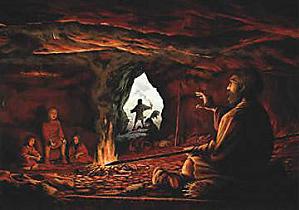
In any human population may be found at least one creative individual who is able to combine into a mental pattern the images of objects experienced by his five senses. This mental pattern may then be converted by his hands into a concrete novel artefact. For instance, one can imagine some Neanderthal genius, making fire for the first time by designing a primitive bow-drill from two sticks and a strip of rawhide. Once the benefits of this novelty had been appreciated and accepted by the community others would copy and reproduce, making the novelty a new 'Invention'. A later inventor, with this added to his ‘objects of experience’ might find a use for it in sharpening wooden spear points. |
|
As inventions multiply, improve and diffuse from their origins their integration may become too complicated for use by the general public and an elite few are trained in the magic and mysteries of a 'Craft'. The dual meaning of the word 'Craft' is no coincidence since most of the techniques employed in the basic crafts had their origins in shipbuilding or navigation. A journeyman craftsmen carries in the conceptual part of his brain the patterns of all the objects he can manufacture. When a number of crafts are working in concert they form a 'Technology'. The scope of this Technology is only limited by the objects within the range of the inventor’s experience. and living conditions offer very contrasting variety of availability. |
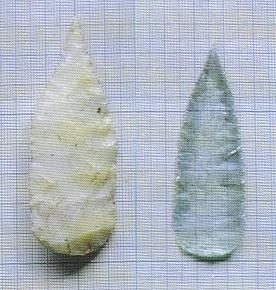
An Australian aborigine, a bushman in the Kalahari desert or an Inuit in the Arctic, have few artefacts compared with the number of natural ones, yet they make full use of the latter. Opposite are two finely retouched and notched points, one porcelain, the other glass. Drven into regions often lacking the kind of stone needed to fashion their traditional tool kit, the Aborigines made use of substitutes unwittingly supplied by the newcomers; a porcelain insulator from a telegraph pole and glass from bottles. |
 |
Claude Levi-Strauss in La Pensee Sauvage , discussing the problems faced by ethnologists studying the logic of totemic classifications, in savage societies writes:
To return - press the Back Button on your browser |